
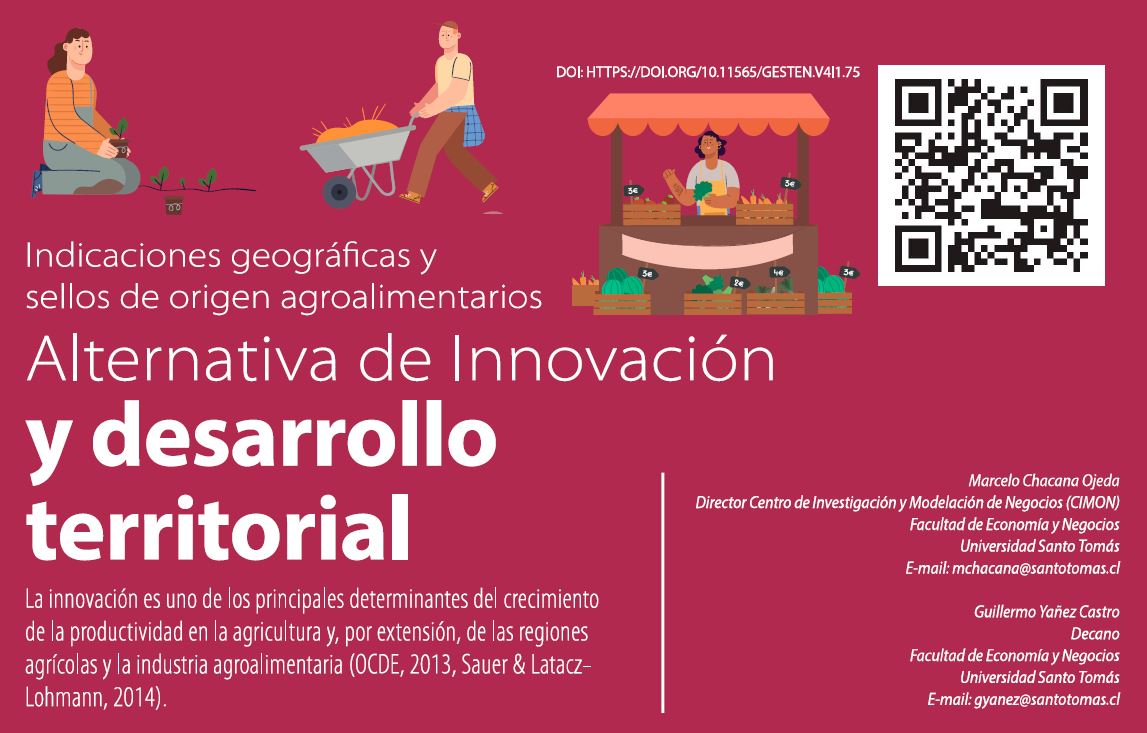
Geographical Indications and Agri-Food Origin Labels as an Alternative for Innovation and Territorial Development
DOI:
https://doi.org/10.11565/gesten.v4i1.75Abstract
The literature abounds in empirical evidence and examples in which geographical indications and agri-food origin labels serve as alternatives for innovation and territorial development. However, establishing a geographical indication or origin label does not on its own guarantee the development of innovations, the development of a territory, or the quality of life of its inhabitants and stakeholders. Such efforts must rest on a robust product-territory differentiation strategy, one that takes account of territorial dynamics. The factors relating to these dynamics must valorize and strengthen local collective action capabilities as a central element of the strategy to be developed, since those capabilities are indispensable for the proper management and use of the label, and a necessary condition for achieving commercial success and sustainability over time.
Downloads
References
Aranda, Y.V., Gómez Muñoz, A.C., Ramos, E. (2014). Incorporación de dinámicas territoriales en un modelo para la selección de sellos de origen”. Revista Española de Estudios Agrosociales y Pesqueros, 237, 13-47.
Asheim, B.T., Lawton Smith, H., Oughton, C. (2011). Regional Innovation Systems: theory, empirics and policy. Reg. Stud, 45 (7), 875–891. DOI: https://doi.org/10.1080/00343404.2011.596701
Belmin, R., Casabianca, F., Meynard, J. (2018). Contribution of transition theory to the study of geographical indications. Environmental Innovation and Societal Transitions, 27, 32-47. DOI: https://doi.org/10.1016/j.eist.2017.10.002
El Bilali, H. (2018). Relation Between Innovation and Sustainability in The Agro-Food System. Ital. J. Food Sci., 30, 200 – 225.
Fonte, M. (2008). Knowledge, food and place. A way of producing, a way of knowing. Sociologia Ruralis, 48(3), 200-222. DOI: https://doi.org/10.1111/j.1467-9523.2008.00462.x
Ghazalian, Pascal L., and W. Hartley Furtan. “The Effect of Innovation on Agricultural and Agri-Food Exports in OECD Countries.” Journal of Agricultural and Resource Economics, vol. 32, no. 3, 2007, pp. 448–461.
Marescotti, A., Belletti, G. (2016). Differentiation strategies in coffee global value chains through reference to territorial origin in Latin American countries. Culture & History Digital Journal, 5(1), 1-14. DOI: https://doi.org/10.3989/chdj.2016.007
Molina, M. (2015). La protección de la denominación de origen, indicación geográfica e indicación de procedencia. Estudio comparativo de las legislaciones de los Estados latinoamericanos y español. RIVAR. 2 (6), 46-69.
OECD, 2013. Agricultural Innovation Systems: A Framework for Analyzing the Role of the Government. OECD Publishing https://dx.doi.org/10.1787/9789264200593-en DOI: https://doi.org/10.1787/9789264200593-en
Paz, R., Rodríquez, R. y González, V. (2009). Desarrollo territorial y eficiencia sistémica. El caso de la cuenca lechera caprina de Santiago del Estero (Argentina). Territorios, 20, 111-134.
Raimondi, V., Curzi, D., Arfini, F., Olper, A., Aghabeygi, M. Evaluating Socio-Economic Impacts of PDO on Rural Areas. In Proceedings of the 7th AIEAA Conference “Evidence-based Policies to Face New Challenges for Agri-Food Systems”, Conegliano (TV), Italy, 14–15 June 2018.
Sauer, J., Latacz-Lohmann, U. (2014). Investment, technical change and efficiency: empirical evidence from German dairy production. Eur. Rev. Agric. Econ, 42 (1), 151–175. DOI: https://doi.org/10.1093/erae/jbu015
Valceschini, E., & Maze, A. (2000). La politique de la qualité agro-alimentaire dans le contexte international. Economie rurale, 258 (1), 30-41. DOI: https://doi.org/10.3406/ecoru.2000.5191
Vandecandelaere, E., Arfini, F., Belletti, G., Marescotti, A. (2010). Uniendo personas, territories y productos. Guía para fomentar la calidad vinculada al origen y las indicaciones geográficas sostenibles, Organización de las Naciones Unidas para la Alimentación (FAO) y SINER-GI.
Downloads
Published
Issue
Section
License
Copyright (c) 2019 GESTIÓN Y TENDENCIAS

This work is licensed under a Creative Commons Attribution-NonCommercial 4.0 International License.
How to Cite
Article usage
- ViewsTimes this article's page was opened since the journal started recording statistics. One person can visit more than once.
- 670
- DownloadsTimes the full text of this article (usually the PDF) was opened or downloaded.
- 323
All time, as recorded by the journal.
Last 2 years: 312 views, 119 downloads.
Main countries of traffic origin:Countries this article was consulted from, according to the internet connection. They are not necessarily people. United States 21% · China 11% · Brazil 9%
0.48 downloads per view (journal average 0.67).Downloads of the full text for every abstract view of this article, compared with the whole journal.
Explore the journal's metrics

